New World
The Knife of Never Letting GoNew World is the settlers’ destination and the setting of a society transformed by unfamiliar forms of communication. What its inhabitants initially understand as a planet ruined by Spackle warfare is more complicated: the Noise was already present when humans arrived, and communication among living things is part of the planet itself. That discovery changes the meaning of New World from a hostile place supposedly damaged by an enemy into an environment whose conditions human settlers never understood.
A Settled Planet and an Uncertain History
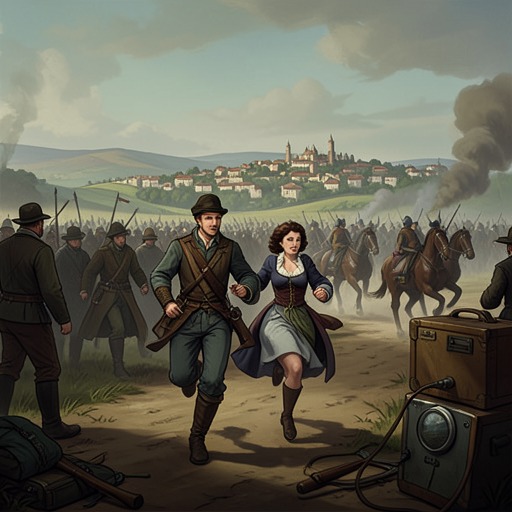
Humans came to New World from the Old World to establish settlements. Todd explains the settlement history as something learned in Prentisstown: the settlers arrived around twenty years earlier, encountered the Spackle, and entered a war after failing to make peace. Ben’s later account places the landings about ten years before Todd’s birth. The accounts do not give the same estimate, but both place human settlement within a recent history shaped by the war and its aftermath.
The initial version of that history treats the Spackle as the source of a series of biological attacks. Todd has been taught that they released germs during the war, that one made animals able to talk, and that another caused the Noise. In this telling, disease killed half the men and every woman, including Todd’s mother; the surviving men were driven mad, and their violence brought about the end of the Spackle. These claims form the inherited explanation Todd repeats to Viola, not a reliable account of the planet’s origins. Ben later directly corrects its central claim about the Noise germ.
The gap between the familiar explanation and Ben’s account also marks the limits of what the settlers know. Todd can describe what every boy in Prentisstown is expected to learn, yet that shared history cannot explain the world he lives in. New World’s past reaches him first as a fixed story about an enemy and only later as a mystery requiring its own explanation.
Communication as an Environmental Condition
Ben says the Noise germ was not a Spackle weapon. It was naturally present in the air when the settlers landed, and within a day people could hear thoughts. The effect did not apply equally to everyone: it was men who experienced the Noise, while the scientists and doctors among the settlers could not explain why. The resulting disruption was severe enough that some men left Haven for more distant communities, hoping to get away from the new condition. Others gradually tried to live with it, as they had to adapt to animals that could talk.
Ben describes the planet as a system of continual information. Everything on New World communicates with other things, whether or not a human wants to receive it. The Spackle, he says, had evolved to live with this condition; the human settlers had not. For men, an excess of information could become Noise and contribute to madness. In this account, Noise is not an invading message or simply a consequence of war. It is the human experience of being exposed to a planetary condition that the settlers were unequipped to manage.
The talking animals belong to the same altered world, although Todd’s inherited account assigns their speech to a different germ from the one associated with Noise. This distinction matters: the unusual communication that defines New World is not a single phenomenon with one known cause. Ben’s explanation establishes the natural origin of Noise, while Todd’s earlier account shows how incomplete and misdirected explanations have circulated among settlers.
Communities and the Cost of Adaptation
The effects of New World’s conditions are social as well as personal. Ben recalls that, after the first shock, men scattered into far communities, moving away from Haven as roads were cut. Communities then found different ways of dealing with the constant information around them. The account presents no single human response that resolves the problem: separation can offer distance, but the planet’s communication does not simply cease because a settlement moves elsewhere.
Prentisstown provides a stark measure of later hardship. From a ridge, Todd sees a small town with one shop where there used to be two, one pub where there used to be two, and a single clinic, jail, police station, and large house for the Mayor. Its population is given as 147, falling to 146 men and one boy who has not yet reached manhood. The reduction is not explained by one cause alone. Some men have killed themselves; others have disappeared, including an old neighbor, a carpenter, and a man who vanished when his son became a man. Todd connects these departures to life in a town with no apparent future, where the remaining men’s Noise bears down on him.
Ben places such hardship in a wider pattern: crops fail, sickness persists, and prosperity does not come. He recalls a poisonous preaching beginning to spread and to blame. The surviving account does not detail the preaching’s full development, but its emergence follows years in which settlements have struggled with environmental, agricultural, and social pressures. New World’s difficulties therefore cannot be reduced to the Noise alone, even though Noise gives those pressures an unusually direct presence in daily life.
Discovery Beyond the Settlements
As Todd and Viola travel along the river, the land opens into plains, low and higher hills, and mountains. The road continues through a landscape without fences, cultivated fields, or visible signs of settlement. Its apparent emptiness prompts a question about whether New World has truly been wiped out. That impression contrasts with Ben’s account of scattered communities and the earlier flight of men from Haven: the travelers’ limited view of the road ahead does not amount to a complete picture of the planet.
Viola’s arrival also brings the settlements’ inherited history into contact with a new wave of colonization. She identifies an Expansion Class Seven colony ship above them and explains that more settlers are coming. Her own ship has crashed, leaving her without a way to contact the others or warn them. The approaching arrival makes the local crisis larger than the survival of Todd and Viola or the history of Prentisstown: people who do not yet know what awaits them are on their way to New World.
The contrast between Viola’s imagined possibilities and the planet’s actual conditions sharpens that uncertainty. Todd thinks of her childhood aboard a spaceship as a life of movement and freedom, unlike life on a planet that seems unwilling to welcome its inhabitants. Yet the settlers’ escape from the Old World has not delivered uncomplicated safety or choice. New World offers space to travel through and the prospect of further settlement, but it also confronts its arrivals with unfamiliar biological conditions, failing communities, and a history they have been taught incorrectly.
Significance
New World is defined less by a simple opposition between habitable and hostile terrain than by the mismatch between its inhabitants and its ways of communicating. The Noise makes information unavoidable for men; animal speech extends that strangeness beyond human society; and the Spackle, initially blamed for the condition, are revealed not to have caused it. That reversal changes how the planet’s conflict can be understood: human fear and violence arose within a world whose basic conditions were misunderstood, rather than from the specific attack on which the inherited story depends.
The setting also makes knowledge consequential. Todd’s explanation to Viola shows how easily a communal account can stand in for firsthand understanding, while Ben’s recollection revises that account without making New World’s hardships disappear. Meanwhile, the coming colony ship threatens to repeat the pattern of arrival without adequate knowledge. The planet is at once a place settlers seek for a new beginning and a force that unsettles the assumptions they bring with them.